The Effect of Behavioural Biases on Financial Decisions
  • All Biases
  • Categories
    • Heuristics and Judgemental Biases
    • Choices: Framing and References
    • Social Factors
  • About

Prospect Theory Biases

Kahneman & Tversky’s Prospect Theory overturned classical expected utility theory by showing that people evaluate outcomes relative to a reference point, and feel losses roughly twice as acutely as equivalent gains.
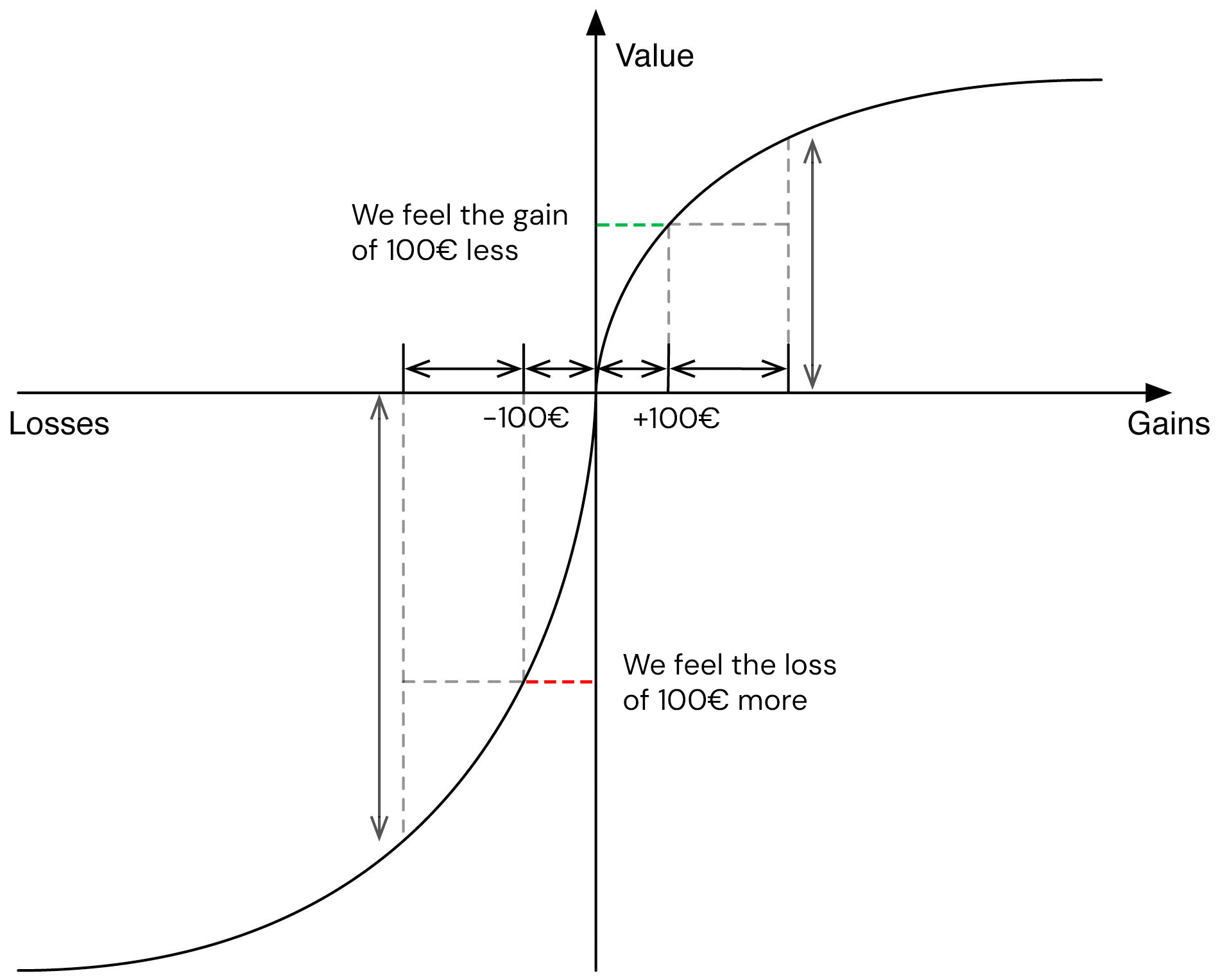
The pain of a loss hurts twice as much as the happiness of a win.
Aversion to a Sure Loss
It’s the instinct to avoid to accept a definitive loss when there is still a chance of recovering it. This can lead to taking a riskier chance that might lead to an even…
Conservatism
Conservatism bias refers to the slow updating of preferences in the face of new information. Combined with Loss Aversion, it leads to slow adaptation to good news but fast…
Favourite-Longshot Bias
It’s when we over-bet on unlike winners and under-bet on favorites. This is why the odds of the favorites in the betting industry tend to be higher than their true…
Hyperbolic Discounting & Present Bias
According to this bias, value is not discounted at a fixed rate over time, but closer rewards are valued much higher than distant ones, at a diminishing rate. In other…
Myopic Loss Aversion
Myopic loss aversion involves evaluating gains or losses over very short timeframes, while being more sensitive to the latter (in line with Loss Aversion).
Reference Dependence
In reference dependence, we don’t evaluate final states in isolation, but changes relative to a reference point. In this context, when gains occur we think of the…
Self-Control and Commitment
It’s when we are unable to recognize that our present and future selves have different needs.
No matching items