The Effect of Behavioural Biases on Financial Decisions
  • All Biases
  • Categories
    • Heuristics and Judgemental Biases
    • Choices: Framing and References
    • Social Factors
  • About

The Effect of Behavioural Biases on Financial Decisions

A collection of cognitive biases and their influence on financial decision-making

Heuristics and Judgemental Biases Choices: Framing and References Social Factors All Biases

What are Behavioural Biases?

Behavioural biases try to explain our tendency to reason in certain ways that can lead to systematic errors or deviations from a standard of rationality or good judgment in thinking or reasoning. In the financial setting, they aim to explain why consumers and investors make decisions that oppose the standard model of rational choice, which states that when presented with a set of options, individuals choose the option that maximizes their expected utility.

This site serves as a catalogue of 44 biases across three major categories, in line with the taxonomy proposed by David Peon and Manel Antelo, including some examples from daily life for each.


Browse by Category

Heuristics and Judgemental Biases

Heuristics are mental "rules of thumb" used to simplify complex decision-making, distorting risk assessment and probability judgement.

Choices: Framing and References

How options are presented (framed) changes what we choose. Frame dependence, context effects, mental accounting, and preference reversals.

Social Factors

Cultural and social factors affect our decision-making, leading to conformity, groupthink and herd mentality.



All Biases

Affect Heuristic
It’s when an easy, emotional assessment (“affect”) replaces a more complex assessment (“target attribute”) that requires more thought, such as e.g. a calculation. This is…

Anchoring and Adjustment
This is a judgment bias where an initial value (the “anchor”) influences subsequent estimates or decisions. While we might adjust from the anchor, the adjustment is usually…

Attention Bias
Attention bias occurs when we focus on the most visually or emotionally prominent features of a decision, rather than the most critical ones. Because our cognitive resources…

Availability Cascades
The more a story is repeated, the more important it appears, in a self-reinforcing process. This can be illustrated as follows:

Aversion to Ambiguity
This bias describes a preference for choices with known probabilities over those with unknown probabilities, regardless of the expected value of each.

Aversion to a Sure Loss
It’s the instinct to avoid to accept a definitive loss when there is still a chance of recovering it. This can lead to taking a riskier chance that might lead to an even…

Base Rate Neglect
It’s when we overweigh specific information we have at hand (“representativeness”) over prior probabilities in the broader population, when making judgements.

Causality and Attribution
When trying to explain the causes of events, we make errors resulting from the prominence of available information, stereotypes etc.

Choice Bracketing
Choice bracketing refers to how we group individual choices into broader or narrower evaluation sets. When bracketing narrowly, we seek the maximum immediate satisfaction;…

Communal Reinforcement & Groupthink
Communal Reinforcement refers to mutual reinforcement through exchange of information (social learning) and it often goes along with confirmation bias. Groupthink, on the…

Confirmation Bias
This bias refers to registering or recalling information that supports one’s pre-existing views while ignoring contradictory evidence.

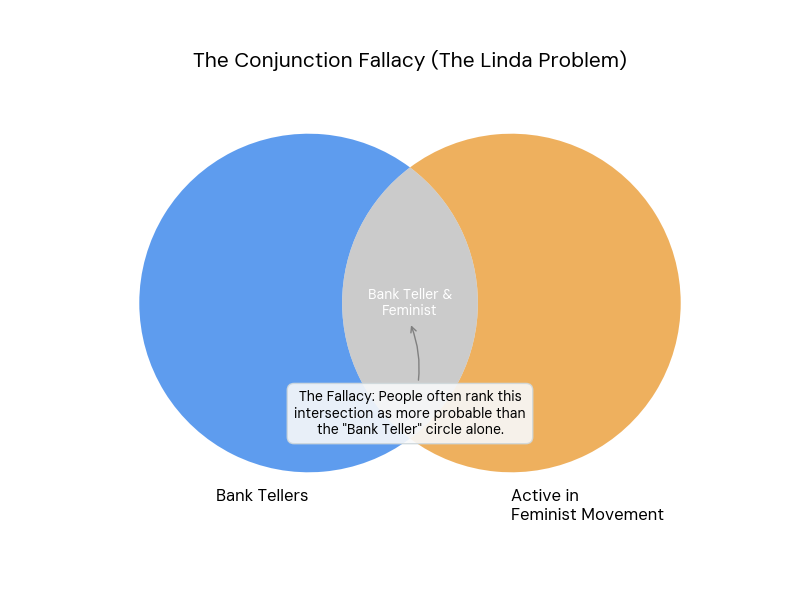
Conjunction Fallacy
The Conjunction fallacy occurs when one believes that the probability of the conjunction of two events (i.e. occurring together) is greater than that of one of its…

Conservatism
Conservatism bias refers to the slow updating of preferences in the face of new information. Combined with Loss Aversion, it leads to slow adaptation to good news but fast…

Context Dependence
Context dependence describes how the same option can be more or less attractive depending on what else is in the choice set. It can further be distinguished into:

Diminishing Sensitivity
According to the Diminishing Sensitivity bias, smaller changes are perceived as more important close to the reference level than changes further away from it.

Excessive Optimism
This bias describes the tendency to believe that good outcomes of events outside our control are more likely than bad outcomes, despite what objective probabilities might…

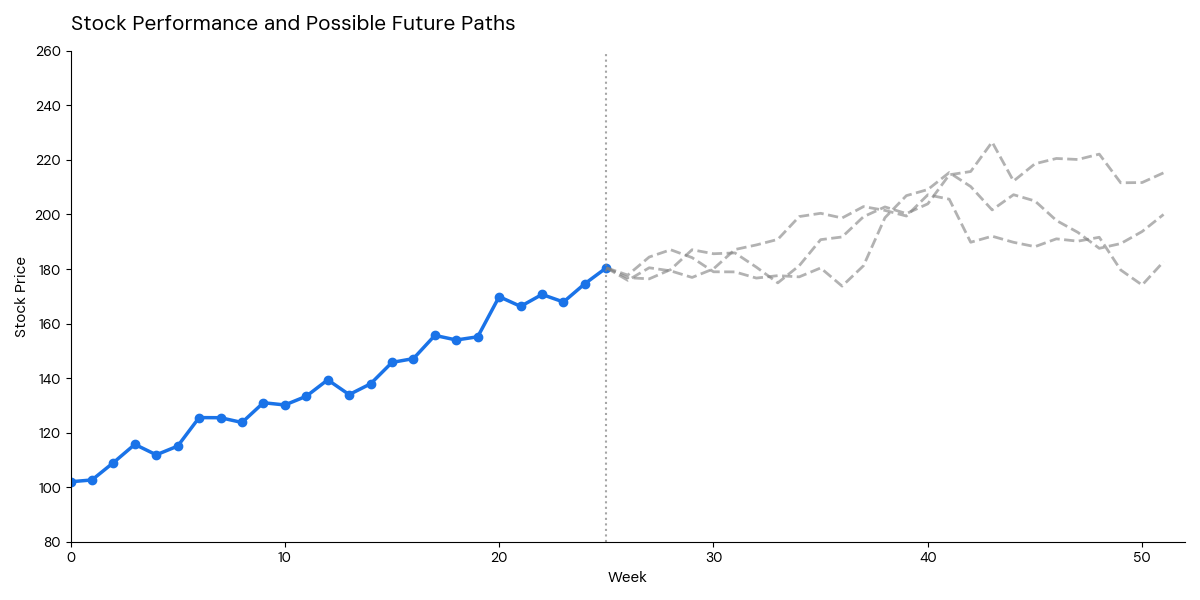
Extrapolation Bias
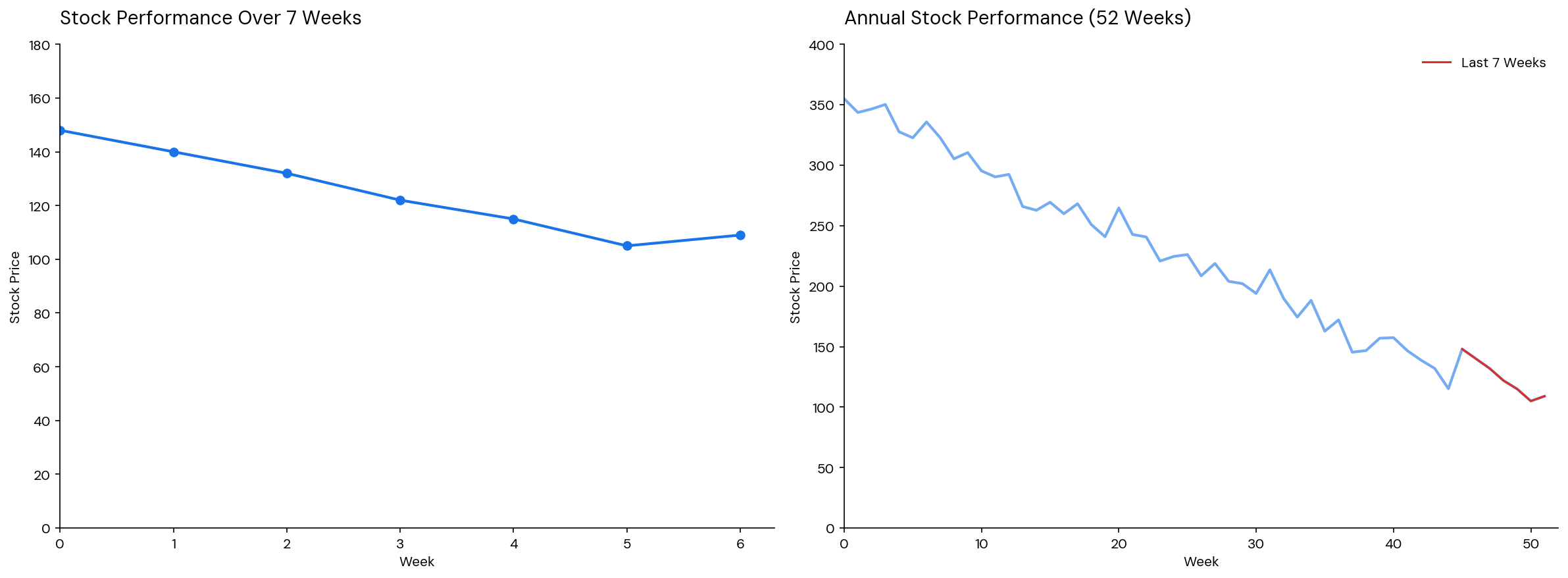
Extrapolation bias is the tendency to believe that recent trends will continue into the future, without accounting for the reasons that might cause them to reverse, such as…

Fairness and Justice
Financial decisions can be affected by considerations of fairness and loyalty, resulting in either abstaining from or favoring particular choices.

Familiarity
The familiarity bias is related to the fact that people tend to fear change and the unknown. Repeated exposure to a brand, option, or idea creates a sense of comfort and…

Favourite-Longshot Bias
It’s when we over-bet on unlike winners and under-bet on favorites. This is why the odds of the favorites in the betting industry tend to be higher than their true…

Fluency Heuristic
The fluency heuristic is a variation of the Recognition Heuristic: when both options are recognised, the one retrieved from memory more easily (faster, more vividly) is…

Gambler’s Fallacy
The gambler’s fallacy is the mistaken belief that, after a run of one outcome of events, there’s bound to be a “reversal” or “balancing out”, and therefore the opposite…

Greed and Fear
Fear in financial decisions may result from the unknown, from change, or from the possibility of collapse. When combined with greed, it can lead to increased risk-taking. In…

Hedonic Editing
It’s when we narrate events in a way that makes us feel happier. We therefore tend to combine losses with larger gains (to reduce pain) or separate gains into smaller parts…

Hindsight Bias
Hindsight bias is when we believe that we predicted the outcome of an event, after it has occured, even when we didn’t. The reason this happens is that, after an event…

Hot Hand Fallacy
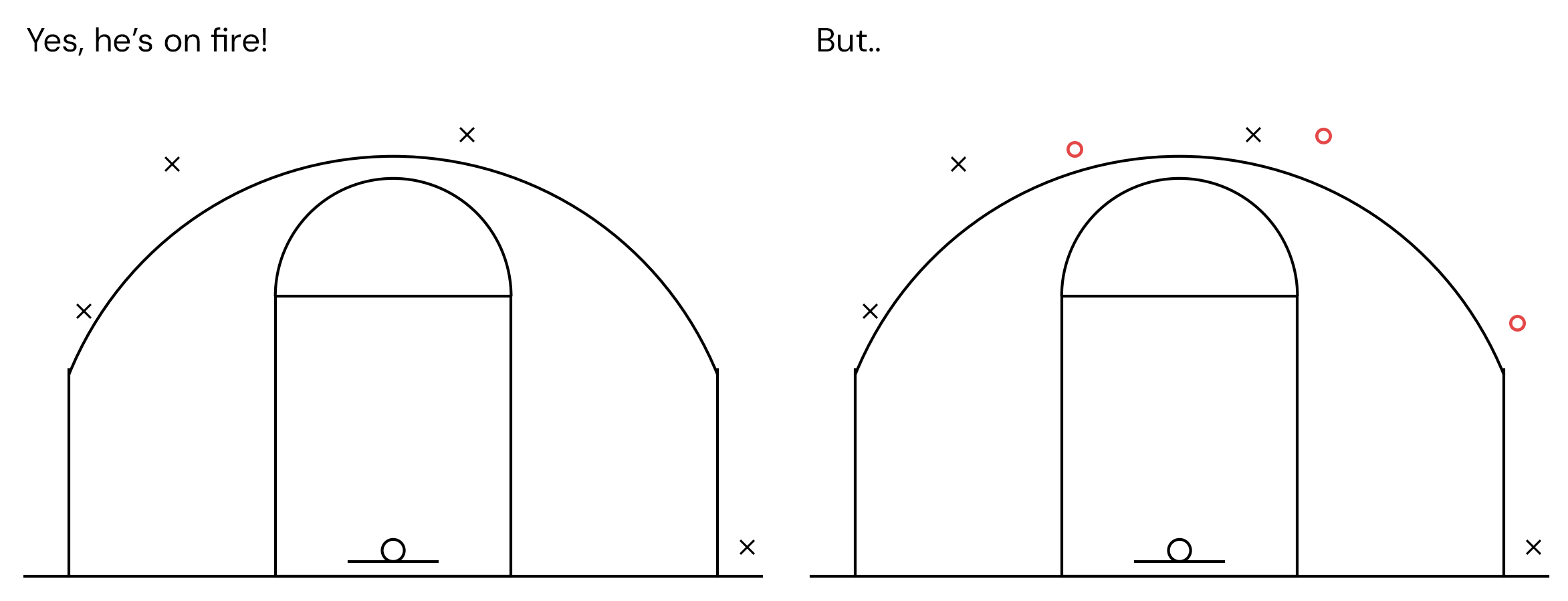
The hot hand fallacy is the belief that long streaks are bound to continue, failing to account for systematic reasons or the statistical independence of events. It’s similar…

Hyperbolic Discounting & Present Bias
According to this bias, value is not discounted at a fixed rate over time, but closer rewards are valued much higher than distant ones, at a diminishing rate. In other…

Illusion of Control
Illusion of control refers to believing that random events are subject to our control (see also the concept of Magical Thinking in psychology).

Illusion of Validity
To think your judgement is valid, even when the evidence you have at hand is weak or unreliable.

Information Cascades
This bias can be summed up as “maybe everyone else knows something I don’t” and it occurs when individuals follow the actions of others while ignoring their own information.

Law of Small Numbers
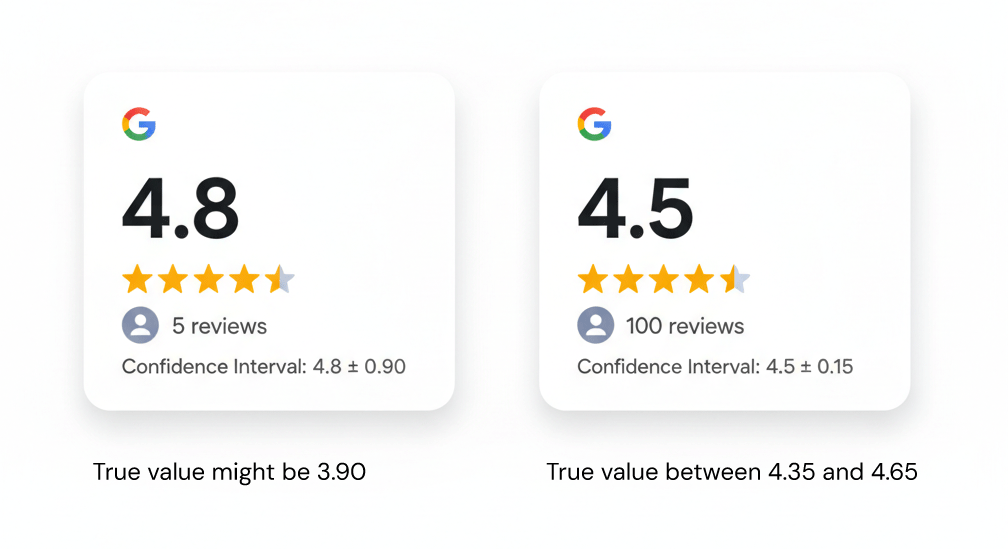
It’s the mistake to believe that a small sample accurately resembles the parent population. In reality, small samples have a small confidence interval and will eventually…

Loss Aversion
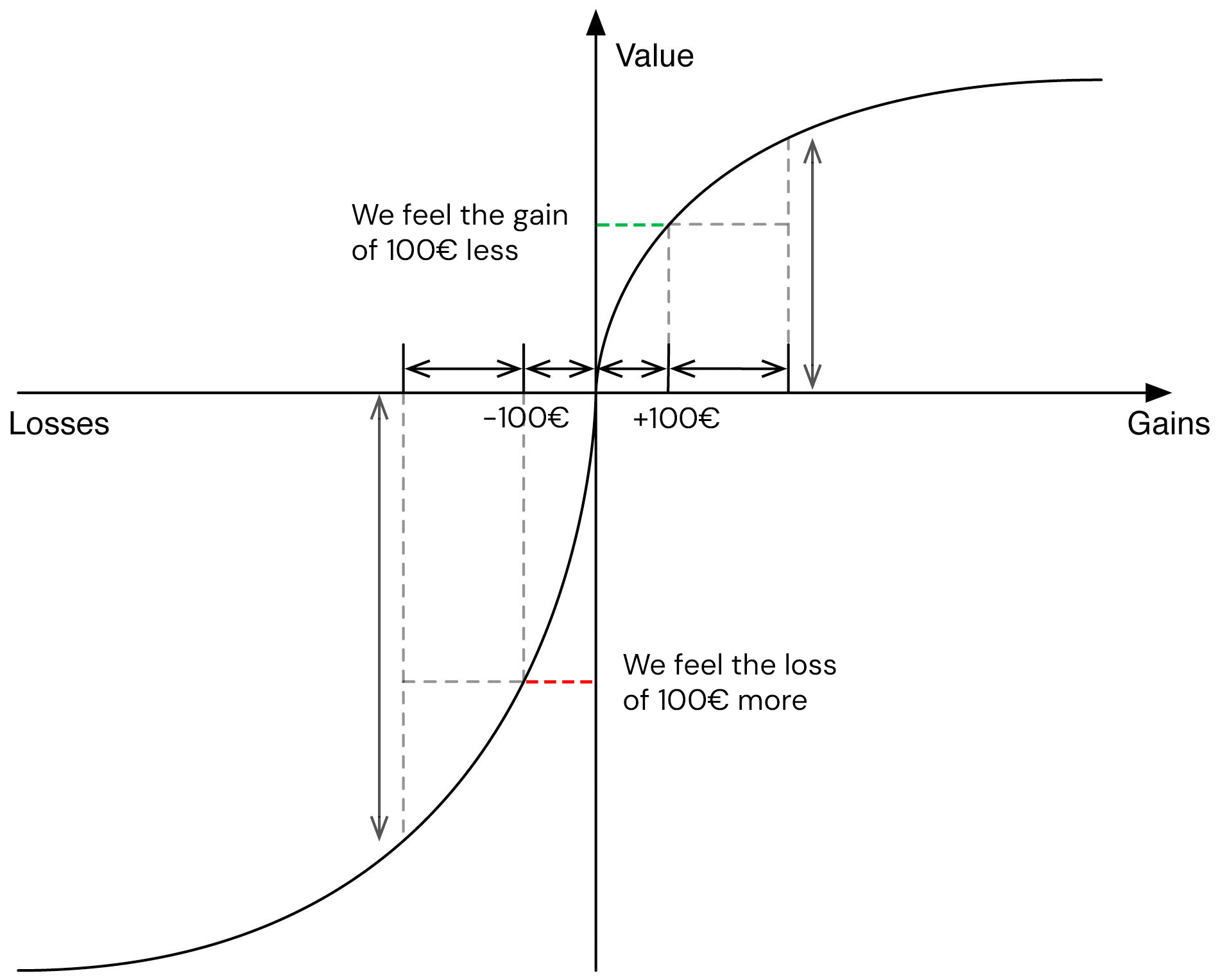
People suffer more from a loss than they enjoy a gain of the same magnitude. This asymmetry is called loss aversion, is central to the Prospect Theory and it may explain why…

Myopic Loss Aversion
Myopic loss aversion involves evaluating gains or losses over very short timeframes, while being more sensitive to the latter (in line with Loss Aversion).

Narrow Framing
It’s the tendency to evaluate events in isolation, rather than considering the whole picture.

Obedience to Authority
Obedience to authority in a financial context means following expert advice even when the data or our views say otherwise. We therefore trust the expert’s status as a…

Overconfidence
Overconfidence is our tendency to overestimate our own skills and it might occur when (a) estimating our own performance (overestimation), (b) our own performance relative…

Prospect Theory Biases
Kahneman & Tversky’s Prospect Theory overturned classical expected utility theory by showing that people evaluate outcomes relative to a reference point, and feel losses…

Recognition Heuristic
This bias involves assigning a higher value to an object we recognize. The heuristic is considered rational when the recognition criterion has some validity.

Reference Dependence
In reference dependence, we don’t evaluate final states in isolation, but changes relative to a reference point. In this context, when gains occur we think of the…

Repeated Gambles
Repeated gambles refer to the failure to account for how individual decisions aggregate over time as cumulative sums. For example, each choice may seem trivial in isolation…

Self-Attribution Bias
When one attributes successful outcomes to their personal abilities but unsuccessful ones to external factors or “sabotage”. This leads to overconfidence, as one might expect!

Self-Control and Commitment
It’s when we are unable to recognize that our present and future selves have different needs.

Social Contagion & Conformity
As a society, we have a tendency toward conformity that is so strong it can lead intelligent, well-meaning people to be willing to call white black.

Status, Envying and Social Comparison
This bias relates to buying products out of jealousy, to boost self-esteem, resulting from the prejudice comparisons create.
No matching items