Conjunction Fallacy
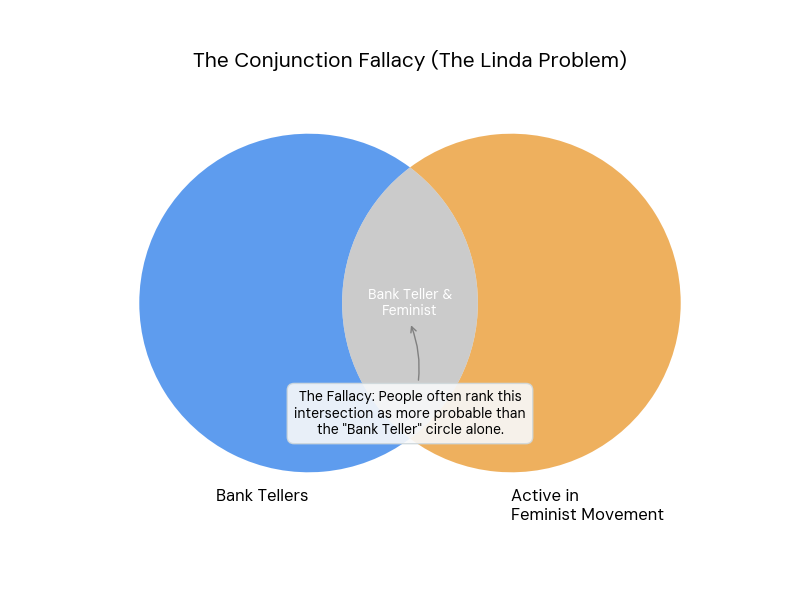
The Conjunction fallacy occurs when one believes that the probability of the conjunction of two events (i.e. occurring together) is greater than that of one of its constituents, i.e. P(A∩B) > P(A) (which is impossible).
It arises because the description feels more representative of the person or situation we’re evaluating, making it seem more probable.
The Linda Problem
In the classic Linda Problem, participants are given a description of a fictional woman named Linda:
“Linda is 31 years old, single, outspoken, and very bright. She majored in philosophy. As a student, she was deeply concerned with issues of discrimination and social justice, and also participated in anti-nuclear demonstrations.”
Participants are then asked which is more probable:
- Option A: Linda is a bank teller.
- Option B: Linda is a bank teller and is active in the feminist movement.
The results showed that 85% of participants chose Option B. However, this is impossible mathematically: the probability of two events occurring together (a conjunction) is always less than or equal to the probability of either one occurring alone.
Also relates to: Representativeness Heuristic · Base Rate Neglect · Overconfidence · Illusion of Validity